Wood Fence Maintenance Costs in Minneapolis (Staining, Sealing, and Lifespan)
October 20, 2026 · 5 min read
A wood fence carries a recurring cost that a homeowner signs up for on install day. The largest part of it is staining or sealing every two to three years. Against that schedule, a wood privacy fence realistically lasts 10 to 15 years in Minneapolis, MN. Skip the maintenance, and it is closer to seven to ten.
We are an expert fence company working across the Twin Cities metro, and wood is not one of the three materials we install. Homeowners still ask us to compare it constantly, though. So here is what the upkeep actually involves, you know, without the sales pitch.
What Minnesota Weather Does to Wood Over Time
Wood is porous, and that single property drives every maintenance task attached to it. Moisture soaks into the grain through spring thaw and summer rain, then freezes inside the material when temperatures drop. The expansion that follows opens the grain a little further each cycle. Boards that looked flat in year two start to cup and warp by year five.
The damage concentrates where water sits longest, so bottom rails and the lower few inches of each picket tend to rot first. Posts are the other pressure point, because a buried post sits in soil that holds moisture year-round.
A wood fence rarely fails uniformly, it fails from the ground up, which puts the repairs in the places hardest to reach. Every material reacts a bit differently to this climate, which is why the best fence types for Minnesota weather are worth a look.
Staining and Sealing Comes Around Every Two to Three Years
Stain and sealer keep moisture out of the grain, and they wear off on a predictable schedule here. Two to three years is the working interval for most properties around Minneapolis, MN.
South- and west-facing runs need it sooner because they take the most sun. Stretching that interval is where most wood fence problems begin, and it is usually when homeowners start calling for fence repair services.
The cost splits along one decision. Doing it yourself means buying stain, brushes, or a sprayer and giving up a weekend for a typical backyard perimeter, so materials are the main outlay.
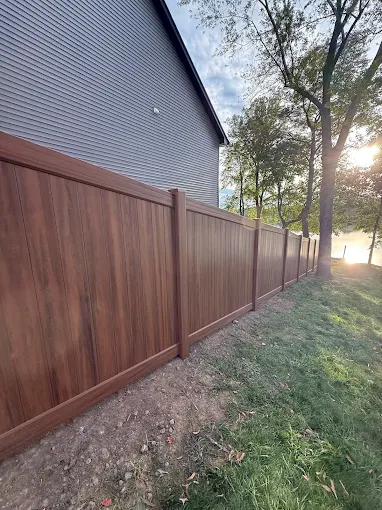
Hiring it out replaces the weekend with a labor bill that scales with footage and height. Either way, the cost repeats every two to three years, and that is the part homeowners rarely total up when comparing materials.
The Recurring Tasks That Set Your Annual Cost
Budgeting for a wood fence works better as an annual figure than a one-time one. These are the tasks that generate the spend, listed roughly in the order they arrive over the fence’s life. Kind of like a to-do list that never quite ends.
- Stain or seal, every two to three years, materials plus either a weekend or a labor bill.
- Pressure washing before each restain, since stain will not bond to a dirty or mildewed surface.
- Board replacement, a handful of warped or split pickets a year once the fence passes a decade.
- Rot repair at bottom rails and posts, the expensive category, arriving from year seven onward.
- Hardware and gate adjustment, annually, as hinges loosen and gates drop out of square.
Spread across a fifteen-year life, those five items often exceed the gap in purchase price between wood and a low-maintenance material. That arithmetic is why vinyl vs. wood fences is a comparison worth making before you buy rather than after. Just do the math early.
Thinking about skipping the yearly upkeep? Give us a call at (612) 310-4279, and we’ll price the low-maintenance options against your actual yard here in the Hugo and Minneapolis area.
What Moves the Cost Up or Down
Linear footage is the base multiplier on every task above. Staining, washing, and inspecting all scale with the length of the fence. Height scales it further, since a six-foot fence carries half again the surface area per foot of a four-foot one. Surface area is what stain gets measured against.
Wood species matters more than most homeowners expect. Cedar carries natural oils that resist rot and insects, which buys longer intervals and a longer overall life than treated pine. Pine costs less at purchase and asks for more attention afterward.
Exposure is the other big factor. A fence under mature trees stays damp and grows mildew faster. A fully exposed south-facing run loses its stain to UV sooner. Two identical fences on one street can sit years apart on schedule.
Lifespan Is What Turns Upkeep Into Total Cost
Ten to fifteen years is the realistic span for a maintained wood privacy fence in Minnesota. Without the staining schedule, serious deterioration can show up in seven to ten years. Hold that range next to the maintenance figures. Put the two side by side, and you get the total rather than the sticker price.
The comparison that follows is straightforward. A correctly installed vinyl fence lasts 20 to 30 years with far less annual upkeep. That is one purchase where wood asks for two, plus five or six staining cycles along the way. For some homeowners, the trade is worth making, particularly where the look of real wood is the whole point.
What the Low-Maintenance Alternatives Ask of You Instead
Vinyl privacy fencing gives you the same solid screening as a wood privacy fence without the staining schedule. It does not rot and does not need sealing, and it just asks for a rinse with a garden hose once a year plus a spring walk of the line. That is the whole program. Chain link and ornamental steel sit in similar territory.
None of these materials is maintenance-free, and anyone who says otherwise is selling. What changes is the scale. A vinyl fence asks for a few hours a year. A wood fence asks for a weekend every second or third year, plus repairs that grow as it ages.
Across all three materials we install, what determines whether a fence reaches its full service life is post depth. Every post we set goes 42 to 48 inches below grade, backed by a 10-year labor warranty. It is a bit unglamorous, but it matters more than almost anything else.
Want to total the fifteen-year cost of both before you decide? Contact us at (612) 310-4279, and we’ll give you real numbers for the low-maintenance side of that comparison.
Related Topics:
