Signs Your Vinyl Fence Needs Replacement in Minneapolis (Not Just Repair)
October 20, 2026 · 5 min read
Repair is the right call when the damage is isolated, and the posts are still holding. Replacement is the right call once the posts have moved, because everything above ground is only as straight as what sits under it. That one distinction settles most of these decisions.
As a trusted fence company in Minneapolis, we’ll tell you when a patch is the smarter move, even though a replacement is the bigger job. Every fence we put in goes down 42 to 48 inches, below the frost line, and carries a 10-year labor warranty. Before you price anything, just stand at one end of your fence and sight down the line.
A Leaning Post That Returns to Its Lean Is the Clearest Signal
Posts carry the entire fence. In Minneapolis, MN, they carry it through a freeze and thaw cycle that runs every year without fail. When a post was set above the frost line, the freezing ground lifts it slightly each winter. One season of that is easy to miss, but after three or four, the post sits visibly out of plumb, and the panels beside it have started to rack.
The test worth running is whether the post stays corrected. A post that gets reset and holds had a one-time problem, usually impact or a soft footing. A post that drifts back to the same lean has lost its footing entirely, and resetting it again buys you one more season and nothing more.
If several posts along one run lean the same direction, the original install went in too shallow across the whole line, and that’s usually when fence replacement services start making more sense than another reset.
Racking Across Multiple Sections Means the Problem Is Below Ground
Racking happens when a panel no longer sits square in its posts. The rails tilt, the gaps between pickets open unevenly, and the top line stops reading level from a distance. A single racked section usually traces back to one post. Racking across three or four sections in a row traces back to the ground.
This is where repair stops being economical. Sorting out vinyl fence panel vs. post failure is the quickest way to tell the two situations apart. Each racked section needs its posts pulled, the old footings removed, new holes dug to depth, and the panels refitted.
Do that across a long run and you’ve paid for a replacement while keeping twenty-year-old panels. The panels are the part with a finite service life. Putting tired ones back on fresh posts leaves you in the same conversation within a few years.
Yellowing Through the Material Is Different From Surface Dirt
Vinyl picks up a film of pollen, dirt, and mildew over a season. That film is what most homeowners see when they think the fence has aged. A garden hose and a soft brush take it off. If the color returns, the material is sound, and you have a cleaning task rather than a replacement decision.
Yellowing that survives a wash is a different matter. Quality vinyl carries UV inhibitors that slow this considerably, but Minnesota summers are long and bright, and lower-grade material eventually chalks or turns through to the core. People often wonder how long a vinyl fence lasts before the color gives out, and this is one of the early hints.
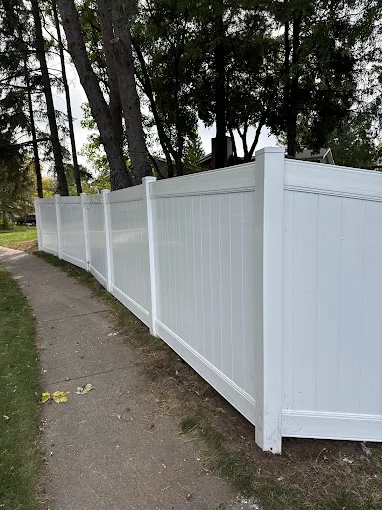
That discoloration is cosmetic in the short term and structural later. The weakening compound is what causes the brittleness that shows up as cracking. A fence yellowed throughout is telling you where it is in its life.
Noticed a post that keeps drifting back, or panels that look a bit off? Give us a call at (612) 310-4279, and we’ll walk your fence line with you before anything gets quoted.
Use This Checklist Before You Call Anyone
Walking the line with a specific list beats a general impression. It also makes the conversation with a contractor much faster. Spring is when these signs read most clearly, because any post movement from the winter has just finished happening.
- Sight the top rail from one end. A line that dips or waves points at post movement rather than panel damage.
- Push each post at shoulder height. Movement you can feel by hand means the footing is no longer gripping.
- Count the racked sections. One is a repair. Three or more in a row is a replacement conversation.
- Wash a test panel. If the color returns, the vinyl is sound. If it stays yellow, the material has aged through.
- Work the gate. A gate that drags or will not latch is usually a shifted post, not tired hardware.
Bring that list to the estimate. It shortens the assessment considerably. It also means you’re checking the contractor’s read against your own rather than taking it on faith.
Cracking in One Panel Is Impact, Cracking Across Many Is Structural
Vinyl gets more brittle as temperatures drop, which is why a cracked panel almost always dates to winter. A snow blower throwing an ice chunk will split a panel at ten below, and so will a branch coming down under snow load. That same panel would have flexed through the impact in July. One crack from an identifiable event is a panel swap and nothing more.
Widespread cracking is a different diagnosis. When panels across a run crack with no single impact behind them, the posts have moved enough to hold the system under constant stress.
The vinyl then fails wherever that stress concentrates. Rail ends pulling out of post slots repeatedly point to the same cause, and once that pattern sets in, refitting the rails only resets the clock on the same failure.
Age and Failure Count Together Decide the Economics
A correctly installed vinyl fence in Minnesota should hold up for two decades or more. It should not show end-of-life signs before year fifteen. If yours is, the install is what deserves review rather than the material. Shallow posts are the usual explanation, and they’re also why a like-for-like repair rarely holds.
The arithmetic gets simple once you count failure points. A fence past twenty years with several problems at once will keep generating repair calls. Three to five years of those costs more than a full rebuild that restarts the warranty clock.
A fence at year eight with one leaning post and one cracked panel is worth repairing without hesitation, and between those cases, post condition is the tiebreaker.
What We Look at During an Assessment
We sight the line before touching anything. The shape of the whole line says more than any single component does. Then we check posts for movement by hand, look at how the rails sit in their slots, and read panel color against a washed section. Gate alignment gets checked last, since a gate usually reports on its posts rather than on itself.
What comes out of that is a straight answer rather than a quote for the larger job. If the fence can be repaired and repair is the right economic call, that is what we say. If replacement is coming within two years regardless of what gets patched now, we say that too. You can then decide whether to spend twice or once.
Want an honest read before another winter works on it? Contact us at (612) 310-4279, and we’ll help you figure out the right next step.
Related Topics:
