Modern vs Traditional Ornamental Fence Designs in Minneapolis (What Homeowners Are Choosing and Why)
October 20, 2026 · 5 min read
Modern ornamental designs run flat-topped, evenly spaced, and unadorned. Traditional designs carry spear tips, finials, scrollwork, and rings borrowed from old wrought iron. Both are powder-coated steel, and both hold up the same way in Minnesota weather. So really, this is a question about the house, not the fence.
We install both as a leading fence company serving Minneapolis and the surrounding suburbs. Every post goes below the frost line, with a 10-year labor warranty behind it. Maybe the easiest move, and it costs nothing, is to go look at your house from the sidewalk before you pick anything.
The Two Styles Come From Different Places
Traditional ornamental fencing descends from wrought iron, and its vocabulary is decorative by design. Pickets finish in spear points or cast finials. Horizontal rails sit at classic proportions, and scrolled panels or circle motifs break up the run. The look reads as established and formal, and on the right house it looks like it has always been there.
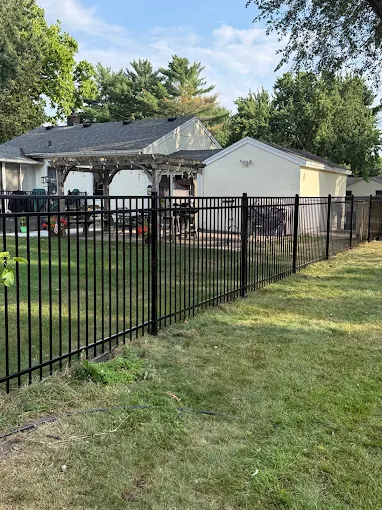
Modern ornamental is a reduction of the same system. Pickets end flush at a flat top rail, spacing stays regular, and the only variation across a run is the gate.
The idea is for the fence to define the boundary without competing with anything, which suits houses where the architecture itself is the feature. Neither approach is a compromise on the other.
The practical difference shows up at a corner, you know. Traditional panels carry their detail around the turn, so a corner becomes a feature in its own right. Modern panels meet at a plain post, and the eye just keeps moving.
On a small city lot with three or four corners in a short run, that changes the whole character of the fence, so walk the route and count the turns before you book fence installation services.
Traditional Suits the Older Housing Stock Across Minneapolis
A great deal of the housing stock in Minneapolis, MN predates the war. Neighborhoods full of Victorians, Tudors, and Colonials carry detail that a flat-top fence tends to undercut. On a house with gable trim, leaded glass, or a wrapped porch, a spear-top fence picks up the existing language. It does not introduce a new one, so the fence stops reading as an addition.
Traditional designs also do something practical on front-yard installs. The vertical rhythm of finials and the weight of a scrolled panel give a short fence real presence, and height alone would not carry that.
That matters where city rules cap front-yard height. A four-foot traditional fence frames a front garden convincingly, while a four-foot flat-top fence in the same spot can read as a bit of an afterthought.
Modern Is What Newer Suburban Builds Keep Choosing
Across the newer developments in the outer metro, flat-top is what homeowners keep landing on. The reason is consistency with what is already on the lot. Contemporary and transitional builds run to clean rooflines, large windows, and simple trim. A scrolled fence in front of one creates a period mismatch that is hard to unsee.
Sightlines are the other reason. Modern ornamental with even picket spacing and no top ornament disappears more completely when you look through it. That suits properties where the point of choosing ornamental over vinyl was keeping the view. For pool enclosures and garden boundaries especially, homeowners want the safety barrier without the visual one.
Spear tips also read differently around a pool than along a front walk. Some families rule them out on that basis alone. The choice of metal matters here too, and aluminum vs. steel fencing is worth weighing before you settle.
Planning a flat-top fence for a newer home around Hugo or the Minneapolis area? Give us a call at (612) 310-4279, and we’ll talk through which style fits your lot before you commit.
Run Through These Before You Choose
The decision gets easier when it is broken into separate questions rather than treated as one aesthetic call. Each of these has a right answer for your property specifically, and none of them depends on taste alone. Take them one at a time, kind of like a checklist.
- Match the house, not the yard. Trim detail and roofline age point to the style. Landscaping changes; architecture does not.
- Check the street. A design that ignores every neighboring fence stands out for the wrong reason.
- Confirm height limits first. Front-yard maximums are often lower than rear-yard maximums, and height changes which designs look right.
- Read your HOA rules before design, not after. Restrictions often cover color, height, and ornament.
- Decide about the gate separately. A gate is where a plain fence can carry detail without the whole run turning decorative.
That fourth point catches more projects than any other, because HOA rules for ornamental fences can vary a lot from one association to the next. Bring your answers to the estimate, and the final design comes together far faster. It really does save a few rounds of back and forth.
Both Styles Perform the Same Through Minnesota Winters
Design does not change durability, which is worth saying plainly. Homeowners sometimes assume the simpler fence is the tougher one. Modern powder-coated steel resists rust, fading, and temperature extremes better than the wrought iron it descends from.
That powder coat is the same whether the picket ends flat or in a spear, and you can see the full range of our ornamental steel fencing in both directions.
What decides longevity is post depth, the same as every fence we install in Minneapolis, MN. Ornamental posts go 42 to 48 inches below grade, under the frost line, so freeze and thaw cannot lift them.
A heaved ornamental post is more obvious than a heaved chain link post. The rigid panels cannot absorb misalignment the way a mesh fence can, so the whole run goes crooked at once.
Where Homeowners Most Often Change Their Minds
The switch we see most often runs from traditional to modern, usually partway through a project. It tends to happen the moment someone sees both options against their own house rather than in a catalog. Ornamental detail photographs beautifully in isolation. In place, across a long run, it can look a bit busy.
The switch in the other direction happens less often but is more decisive. It tends to come from owners of older homes who started with flat-top because it seemed like the safer, more current choice. Then they realized the fence was fighting the house. In that case, the traditional design is not nostalgia, it is just the correct answer to what is already standing there.
One more change has nothing to do with style. Homeowners settle on a design, then find out their front-yard height limit is lower than they assumed, and the proportions they picked no longer work. Checking that limit early costs one phone call. Finding out after the design is locked means starting the whole conversation over.
Want to see both options against your own house before you decide? Contact us at (612) 310-4279, and we’ll bring style samples out to the property.
Related Topics:
